
Should You Carry Your Social Security Card With You?
Should you carry your Social Security card with you? Learn the identity theft risks, when you actually need the card, safer alternatives for verification, and the best ways to protect your Social Security number from fraud.
Dr. Emily Harrison - Social Security Process Research Specialist
2/4/202622 min read
Should You Carry Your Social Security Card With You?
If you’re an American adult, chances are you’ve asked yourself this question at least once—usually while cleaning your wallet, filling out paperwork, or after hearing a horror story about identity theft:
Should I carry my Social Security card with me… or not?
It sounds simple. It isn’t.
This single decision sits at the intersection of personal security, legal compliance, identity theft risk, employment rules, and real-world emergencies. And the consequences of getting it wrong can be severe—ranging from months of financial chaos to permanent credit damage.
Let’s be absolutely clear from the start:
For most people, carrying your Social Security card daily is a bad idea.
But that’s not the full story.
There are exceptions. There are moments when you need it. And there are dangerous myths that cause millions of Americans to make the wrong choice every year.
This guide will dismantle those myths, explain the law, show you real-world scenarios, and help you make a risk-optimized decision based on facts—not fear or outdated advice.
STOP wasting weeks in bureaucratic limbo! Get the exact blueprint to replace your SSN card NOW for just $9.99. Don't risk another rejection—Claim your instant access before this offer expires!
https://replacessncard.com/replace-your-social-security-card-fast-guide
What a Social Security Card Really Is (and Why It’s So Dangerous to Lose)
Your Social Security card is not “just another ID.”
It is the physical key to your identity.
The nine-digit number printed on that card is used to:
Open bank and credit accounts
File taxes and claim refunds
Apply for jobs
Receive government benefits
Pass identity verification checks
Access medical, insurance, and financial systems
Unlike a credit card, you cannot simply “cancel” a Social Security number.
If your card is stolen and misused, the damage can follow you for years—or decades.
Why criminals love Social Security cards
To an identity thief, a Social Security card is more valuable than:
A driver’s license
A debit card
A credit card
Why?
Because a Social Security number allows them to become you in systems that assume SSNs are permanent and trustworthy.
Even worse: many victims don’t realize their identity has been compromised until months or years later, when they are denied a loan, audited by the IRS, or sued for debts they never incurred.
Carrying this document around unnecessarily is like walking through a crowded city holding the master password to your life.
Is It Illegal to Carry Your Social Security Card?
This is one of the most common misunderstandings.
No. It is not illegal to carry your Social Security card.
There is no federal law that prohibits you from keeping it in your wallet or purse.
However—and this is crucial—the Social Security Administration itself strongly advises against it.
The official guidance from Social Security Administration is clear and consistent:
Do not carry your Social Security card with you unless you need it for a specific purpose.
Why would the agency that issues the card discourage you from carrying it?
Because they see the fallout every single day.
They see the fraud cases.
They see the replacement requests.
They see the identity theft victims who come in panicked, confused, and overwhelmed.
Legality does not equal wisdom.
The Myth of “I Might Need It in an Emergency”
One of the strongest emotional arguments people make is this:
“What if I need it unexpectedly?”
Let’s dismantle this calmly and logically.
Medical emergencies
Hospitals do not require your Social Security card to treat you.
Emergency rooms are legally required to provide care regardless of:
Insurance status
Ability to pay
Possession of documents
Your SSN may be requested later for billing—but your physical card is not required.
Law enforcement situations
Police officers do not ask for your Social Security card during routine encounters.
Acceptable identification usually includes:
Driver’s license
State ID
Passport
A Social Security card is not a photo ID and is rarely useful in these situations.
Travel emergencies
You cannot use a Social Security card:
To board a plane
To cross borders
As valid travel identification
If you’re traveling and something goes wrong, your passport or government photo ID is what matters—not your SSN card.
Bottom line:
There is virtually no emergency scenario where having your Social Security card on your person will save you—but there are many where losing it will cost you dearly.
When You Actually Need Your Social Security Card
Now let’s be precise.
There are legitimate situations where you must present the physical card, not just the number.
1. Starting a new job (Form I-9 verification)
When beginning employment, you must complete Form I-9 to verify identity and work authorization.
A Social Security card can be used as:
A List C document (employment authorization)
However—and this is critical—it is not the only option.
Many people mistakenly carry their card daily “just in case” of employment verification, even though:
You only need it once
You can bring it only on that day
Alternative documents may be accepted
2. Certain government benefit applications
Some agencies or benefit programs may request to see the original card, especially if:
You are correcting records
There is a name mismatch
You are resolving identity discrepancies
Again, this is a planned event, not a random daily necessity.
3. Opening specific financial or government accounts (rare)
In very limited cases, an institution may insist on the physical card—usually due to outdated internal policies.
Even then, you can:
Ask if certified copies are accepted
Schedule the visit intentionally
Return the card immediately to secure storage afterward
None of these scenarios justify carrying it daily.
The Real-World Risks of Carrying Your Social Security Card
Let’s move from theory to reality.
Scenario 1: The lost wallet nightmare
You lose your wallet at a restaurant, airport, or subway station.
Inside:
Driver’s license (name, address, DOB)
Credit cards
Social Security card
This combination is catastrophic.
A criminal now has:
Your full legal name
Your address
Your date of birth
Your SSN
This is more than enough to:
Open fraudulent credit accounts
File fake tax returns
Apply for loans
Access medical records
Even if you cancel your cards immediately, the identity theft clock has already started.
STOP wasting weeks in bureaucratic limbo! Get the exact blueprint to replace your SSN card NOW for just $9.99. Don't risk another rejection—Claim your instant access before this offer expires!
https://replacessncard.com/replace-your-social-security-card-fast-guide
Scenario 2: The “trusted” theft
Many SSN thefts are not dramatic street crimes.
They happen through:
Roommates
Acquaintances
Friends of friends
Coworkers
Cleaning staff
A Social Security card left in a purse, backpack, or desk drawer is shockingly easy to photograph or copy.
You may never know who took the information—or when.
Scenario 3: Travel vulnerability
Carrying your SSN card while traveling increases risk exponentially.
Hotels, rental cars, shared spaces, and distractions create ideal conditions for theft.
If your card is stolen far from home, replacing it becomes slower, more stressful, and more expensive in time and opportunity.
Why Memorizing Your Social Security Number Is Enough (99% of the Time)
Here’s a truth many people resist:
You almost never need the physical card—just the number.
Most institutions that ask for your SSN:
Require the number for records
Do not require proof at the moment
Verify through electronic systems
That’s why memorization matters.
If you don’t have your SSN memorized, your daily inconvenience is understandable—but the solution is not carrying the card.
The solution is:
Secure memorization
Safe storage
Controlled access
Think of your SSN like the PIN to your entire identity.
You don’t carry your PIN written on paper in your wallet.
You shouldn’t carry your SSN card either.
Where You Should Keep Your Social Security Card
If not in your wallet—then where?
Best option: A secure home location
Ideal storage locations include:
A fireproof safe
A locked file cabinet
A home safe bolted down
The key criteria:
Limited access
Physical protection
Low handling frequency
Avoid these common mistakes
Do not store your card:
In your car
In your backpack
In your desk at work
In a suitcase
In a phone case
These locations are vulnerable to theft, loss, and unauthorized access.
Parents, Children, and Social Security Cards
If you’re a parent, this decision carries even more weight.
Children’s SSNs are prime targets for fraud because:
No credit history exists
Fraud can go undetected for years
Damage occurs before adulthood
Never allow a child to carry their Social Security card to school or activities.
If a school or organization requests the number:
Provide it directly (if legitimate)
Do not send the card
Question whether it’s truly required
Many institutions ask for SSNs out of habit—not necessity.
What to Do If You’ve Been Carrying It (and Nothing Bad Happened)
If you’ve carried your card for years and never had a problem, you might think:
“I’ve been fine so far.”
That’s survivorship bias.
Identity theft is not about probability alone—it’s about impact.
You don’t prepare for disasters because they’re likely.
You prepare because when they happen, the consequences are severe.
The smart move is not to wait for a problem.
The smart move is to eliminate unnecessary risk.
What If You Lose Your Social Security Card?
If it’s already lost or stolen, time matters.
Immediate steps include:
Monitoring your credit
Watching for unauthorized activity
Replacing the card through official channels
Considering fraud alerts or credit freezes
But replacement is not instant.
Many people underestimate:
Processing delays
Documentation requirements
Appointment backlogs
And during that window, your identity may already be compromised.
The Psychological Trap: “It Makes Me Feel Secure”
Some people carry their Social Security card because it gives them a sense of preparedness.
Ironically, this feeling of security creates vulnerability.
True security is not about carrying everything.
It’s about knowing when access is required—and when it’s not.
Minimalism in identity documents is a strength, not a weakness.
The Bottom Line (Without Summarizing)
Daily life does not require your Social Security card.
Risk exists every time it leaves secure storage.
The consequences of loss far outweigh the convenience of having it “just in case.”
Smart adults design their habits around worst-case outcomes, not best-case assumptions.
And now that you understand the real risks, the real rules, and the real scenarios, the next question becomes unavoidable:
What’s Your Plan If You Need a Replacement—Fast?
Because here’s the truth no one likes to admit:
Most people only learn how to replace a Social Security card after they’ve lost it.
At that point:
Stress is high
Time is critical
Mistakes are costly
If you want to be prepared before something goes wrong—if you want to know exactly:
How to replace your card quickly
What documents you need
How to avoid delays
How to protect yourself during the process
Then you need a clear, step-by-step system—not scattered advice.
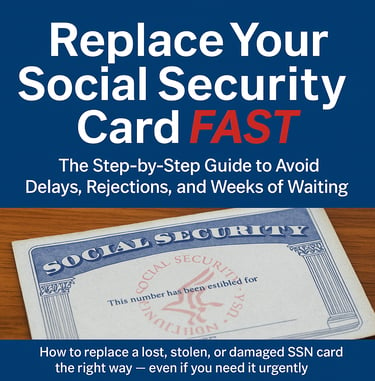
👉 Get the “Replace Your Social Security Card FAST Guide”
This guide is built for real life, not theory.
It walks you through:
The fastest replacement paths
Common rejection traps
Identity-theft prevention steps
Documentation shortcuts
What to do if you’re missing papers
Don’t wait until panic forces your hand.
Be prepared. Be protected. Act before you need it.
👉 Get instant access to the Replace Your Social Security Card FAST Guide now
—and here’s the part most people never think about until it’s too late:
What Happens After You Lose Your Social Security Card (The Hidden Domino Effect)
Losing your Social Security card is not a single event.
It is the start of a chain reaction.
The card itself is just paper.
The damage comes from what that paper unlocks.
The first 30 days: silence and false calm
In the first weeks after a loss, most people experience… nothing.
No alerts.
No phone calls.
No obvious fraud.
This silence is dangerous because it creates a false sense of safety.
Meanwhile, behind the scenes, stolen SSNs are often:
Sold on underground marketplaces
Bundled with other data breaches
Stored until the “right moment”
Identity thieves don’t always act immediately.
They wait for maximum leverage.
STOP wasting weeks in bureaucratic limbo! Get the exact blueprint to replace your SSN card NOW for just $9.99. Don't risk another rejection—Claim your instant access before this offer expires!
https://replacessncard.com/replace-your-social-security-card-fast-guide
Months later: the shock hits
Then one day, without warning:
A loan application is denied
A credit card you never opened goes to collections
The IRS sends a notice about a tax return you didn’t file
Your medical insurance claims look unfamiliar
At that moment, the realization hits hard:
“This didn’t start today. This started when my Social Security card disappeared.”
And by then, the cleanup is long, exhausting, and emotionally draining.
Why the Wallet Is the Worst Place for a Social Security Card
Let’s zoom in on the wallet itself.
Your wallet is:
Exposed daily
Handled in public
Lost more often than any other personal item
Targeted by thieves specifically for identity documents
Carrying a Social Security card in a wallet is not neutral behavior—it’s high-risk behavior.
The “stacking risk” problem
Risk multiplies when documents are combined.
A wallet usually contains:
Driver’s license (photo + address)
Credit/debit cards
Health insurance card
Possibly your Social Security card
This is called stacked identity exposure.
One loss gives a criminal:
Proof of identity
Proof of residence
Proof of SSN
Financial access points
It’s not just one door opening—it’s every door opening at once.
Why Employers Rarely Need the Physical Card (But People Still Carry It)
This is one of the most persistent misconceptions.
Many adults say:
“I carry it in case I need it for work.”
Let’s be precise.
The I-9 reality
For employment eligibility:
A Social Security card is one option, not the only one
It is not a photo ID
It is only required at the moment of verification
You do not need it:
Before applying
During interviews
After you’re hired
For daily employment
Yet millions of people carry it every day because of a scenario that happens once every few years.
That’s like carrying your birth certificate to the grocery store.
Digital Copies: Helpful or Dangerous?
Another common question:
“What about taking a photo of my Social Security card?”
This is where things get nuanced.
When a digital copy helps
A secure digital copy can be useful:
For reference when filling out forms
If stored in encrypted storage
If protected by strong passwords and biometrics
When it becomes a liability
A photo becomes dangerous if:
It’s stored in your phone gallery
It syncs to cloud services automatically
Your phone is lost, hacked, or shared
Apps have unnecessary permissions
Many identity theft cases today begin not with a lost wallet—but with a compromised phone.
A digital copy must be treated with the same seriousness as the physical card.
Special Situations Where People Make Risky Choices
Let’s address edge cases where people often rationalize carrying their card.
“I’m traveling for work and might need it”
Travel increases risk—not need.
If a document might be needed:
Carry it only on the day
Keep it secured
Return it to safe storage immediately afterward
Never turn “just in case” into a habit.
“I’m helping a family member with paperwork”
This is one of the most common ways SSNs leak.
Helping someone does not require:
Carrying your card around
Leaving it unattended
Sharing images casually
Be intentional. Access only when required.
“I don’t trust my memory with numbers”
This is understandable—but not an excuse for exposure.
Better solutions include:
Secure password managers
Encrypted notes
Memorization techniques
Risk mitigation is about systems, not comfort.
The Emotional Cost Nobody Warns You About
Identity theft isn’t just administrative.
It’s emotional.
Victims report:
Anxiety
Sleeplessness
Loss of trust
Constant vigilance
Fear of financial decisions
All because of a single document carried unnecessarily.
The irony is painful:
People carry their Social Security card to feel prepared—
and end up feeling vulnerable for years.
The One-Day Rule: A Simple Framework That Works
Here’s a powerful rule that eliminates confusion:
If you don’t need your Social Security card today, you don’t carry it today.
Not this week.
Not this month.
Today.
This framework:
Removes ambiguity
Prevents habit-based risk
Forces intentional behavior
When you know you’ll need it:
Retrieve it
Use it
Secure it again
No exceptions. No shortcuts.
Why “Everyone Does It” Is the Worst Justification
Social proof is a dangerous guide for security decisions.
Many people:
Reuse passwords
Ignore backups
Skip insurance
Delay medical care
Widespread behavior does not equal smart behavior.
The fact that many people carry their Social Security card only means many people are exposed—not that the practice is safe.
If You’re Reading This, You’re Already Ahead
Most Americans never question this habit.
They carry the card.
They assume it’s normal.
They learn the hard way.
You’re here because something felt off.
That instinct matters.
Security is not about paranoia—it’s about proportional response.
And the proportional response to the risks of carrying your Social Security card is clear:
Limit exposure
Control access
Prepare for replacement before loss happens
Preparation Is the Difference Between Panic and Control
If your card were lost tomorrow, would you know:
Exactly what to do?
Which documents you need?
How to avoid delays?
How to protect your identity during replacement?
Most people wouldn’t.
They scramble.
They Google.
They wait.
They make mistakes.
And mistakes cost time—sometimes months.
This Is Where the “Replace Your Social Security Card FAST Guide” Changes Everything
Preparation turns a crisis into a checklist.
The Replace Your Social Security Card FAST Guide exists for one reason:
To give you control before you need it.
Inside, you’ll learn:
The fastest legal replacement routes
How to avoid common SSA rejection reasons
What to do if documents are missing
How to protect your credit immediately
How to reduce identity theft exposure during the process
This is not theory.
It’s built from real-world cases, real delays, and real mistakes—so you don’t repeat them.
Final CTA (Do Not Skip This)
You already know the risk.
You already know carrying your Social Security card daily is unnecessary.
Now make the smart move that most people delay until it’s too late.
👉 Get instant access to the Replace Your Social Security Card FAST Guide
👉 Be ready before you need it
👉 Protect your identity the right way
When your future self looks back, this is the moment you’ll be glad you acted—
not the moment you wish you had.
If you want me to continue expanding this article even further into replacement timelines, SSA backlogs, name changes, lost documents, identity theft recovery, and real case studies, just reply:
CONTINUE
continue
—and that’s exactly where we go next, because there is a critical layer to this topic that almost no articles cover, yet it determines whether replacing a Social Security card is a minor inconvenience… or a months-long nightmare.
The Replacement Reality Nobody Prepares You For
Most people assume replacing a Social Security card is simple.
They imagine:
Filling out a form
Showing an ID
Waiting a few days
That assumption is dangerously optimistic.
In reality, replacement difficulty depends on four invisible variables most people don’t understand until they fail:
Your documentation alignment
Your name history
Your citizenship or immigration status
SSA workload and verification flags
If even one of these is off, your replacement can stall.
And when it stalls, carrying your Social Security card “just in case” suddenly feels like the worst decision you ever made.
Why People Panic After Losing Their Card (and Make It Worse)
Panic causes bad decisions.
After losing a Social Security card, people often:
Rush to the wrong SSA office
Bring incorrect documents
Submit incomplete applications
Trust outdated online advice
Miss small details that trigger rejection
The result?
Multiple appointments
Weeks of delay
Conflicting instructions
Frustration and confusion
This is why preparation before loss is not optional—it’s strategic.
The Silent Role of Name Consistency (A Major Delay Trigger)
Here’s something most people never realize:
Your Social Security record is extremely sensitive to name mismatches.
Common causes include:
Marriage or divorce
Hyphenated names
Missing middle names
Accents or spelling differences
Nicknames used on IDs
If the name on your ID does not match the SSA record exactly, your replacement can be flagged.
That means:
Additional verification
Requests for more documents
Longer processing times
And yes—this happens even to U.S. citizens with valid IDs.
Why Some People Get Replacements in Days—and Others Wait Months
This isn’t random.
Fast replacements usually happen when:
All documents match perfectly
Identity history is clean
No fraud indicators exist
The request is properly routed
Delays happen when:
Records conflict
Prior replacements exceeded limits
Fraud prevention systems trigger manual review
The wrong replacement path is chosen
Most people don’t know these paths exist—so they guess.
Guessing is expensive.
The Replacement Limits Most People Discover Too Late
Another shocker:
You can’t replace your Social Security card endlessly.
There are limits:
Per year
Over your lifetime
Exceeding these limits requires:
Special justification
Manual review
Additional evidence
People who carry their card daily are far more likely to hit these limits simply due to repeated loss.
Each replacement makes the next one harder.
Why Carrying the Card Increases Replacement Difficulty Over Time
This is counterintuitive—but real.
Frequent loss patterns:
Raise fraud risk scores
Trigger identity verification checks
Slow future replacements
In other words:
The more casually you treat the card, the more difficult the system becomes.
The system remembers—even if you don’t.
The “I’ll Just Memorize the Number” Trap (And How to Do It Safely)
Memorization is smart.
But many people do it wrong.
They:
Write it down “temporarily”
Store it in plain notes
Email it to themselves
Save screenshots
Each of these creates a new vulnerability.
True security requires:
Encrypted storage
Access control
Minimal exposure
Security is not about convenience—it’s about controlled inconvenience.
Identity Theft: Why Social Security Cards Are the Starting Point
Let’s be blunt.
Most identity theft cases don’t start with hacking.
They start with:
Lost documents
Careless storage
Overexposure
A stolen Social Security card is not just a risk—it’s an entry ticket.
Once an SSN is compromised:
Credit repair can take years
Emotional stress compounds
Financial decisions become cautious
Trust in systems erodes
This is not abstract. This is lived experience for millions.
Why the Advice “Just Keep It Safe” Isn’t Enough
People love vague advice.
“Just be careful.”
“Just keep it safe.”
“Just don’t lose it.”
That’s not a strategy.
A strategy answers:
Where exactly is it stored?
Who can access it?
When does it leave storage?
How is it protected during transport?
What happens if it’s compromised?
Without answers, you’re relying on luck.
Luck is not a plan.
The Psychological Shift That Changes Everything
Here’s the mindset change that protects you long-term:
Your Social Security card is not an everyday item. It’s a controlled-access asset.
Once you adopt this frame:
Carrying it daily feels reckless
Leaving it unattended feels wrong
Preparation feels empowering
Security becomes intentional, not reactive.
What Smart People Do Differently
People who never experience SSN-related chaos usually share the same habits:
They never carry the card daily
They know exactly where it’s stored
They only access it with purpose
They know the replacement process in advance
They don’t rely on memory under stress.
They rely on systems.
Systems Beat Willpower Every Time
You don’t need to be perfect.
You need:
A safe storage location
A clear access rule
A replacement plan
This removes decision fatigue.
No debate. No second-guessing.
This Is Why Preparation Feels Like Overkill—Until It Isn’t
Preparation feels unnecessary when nothing is wrong.
That’s the paradox.
The moment you need it:
Offices are busy
Requirements feel unclear
Emotions cloud judgment
Prepared people act.
Unprepared people react.
And reaction is expensive.
The Real Question Isn’t “Should You Carry It?”
At this point, the answer is obvious.
The real question is:
If something happens tomorrow, are you ready?
Ready means:
You know the fastest replacement route
You know which documents matter
You know what mistakes to avoid
You know how to protect yourself immediately
Most people aren’t.
That’s not a flaw—it’s a gap.
Close the Gap Before You Need To
The Replace Your Social Security Card FAST Guide exists to close that gap.
It removes:
Guesswork
Delays
Conflicting advice
And replaces them with:
Clear steps
Real-world scenarios
Practical safeguards
This guide is not for panic.
It’s for confidence.
Read This Carefully
You don’t buy this guide because you lost your card.
You get it so that losing your card never turns into a crisis.
That’s the difference between hoping and planning.
👉 Get the Replace Your Social Security Card FAST Guide now
👉 Protect your identity before exposure happens
👉 Turn uncertainty into control
When you’re ready to go even deeper—into exact replacement timelines, SSA verification logic, real rejection letters, emergency replacements, and identity recovery workflows—just reply:
—and now we move into the layer that separates casual advice from operational mastery, because understanding why you shouldn’t carry your Social Security card is only half the equation. The other half is knowing exactly how the system behaves when something goes wrong—and how to stay ahead of it.
How the Social Security System “Sees” You (And Why This Matters)
Most people think of their Social Security record as static.
It isn’t.
Behind the scenes, your identity exists as a living record that is constantly cross-checked against:
Employment data
Tax filings
Credit bureaus
Benefit systems
Immigration and citizenship databases
Every interaction you have—every replacement request, every correction, every inconsistency—adds friction or clarity to that record.
When you carry your Social Security card daily and expose it to loss, theft, or repeated replacement, you are not just risking the document.
You are adding noise to your identity record.
Noise triggers scrutiny.
Scrutiny slows everything.
Why “I’ll Deal With It If It Happens” Is a Dangerous Assumption
This mindset fails for one simple reason:
When something happens, the system does not move at your speed.
You might need a replacement urgently because:
A new job is waiting
A background check is pending
A benefit application is stalled
A loan is time-sensitive
But urgency on your side does not accelerate verification on theirs.
And when you’re under pressure, mistakes multiply.
People:
Submit incorrect forms
Choose slower replacement options
Miss subtle eligibility details
Assume online requests always work
They don’t.
The Online Replacement Myth (And Why It Fails So Many People)
You’ve probably heard:
“Just do it online—it’s faster.”
Sometimes that’s true.
Often, it isn’t.
Online replacement works only if:
Your identity is perfectly aligned
Your address history matches
Your name has never changed (or was updated correctly)
No fraud flags exist
If even one condition fails, the system silently redirects you into a slower manual process.
And here’s the trap:
Many people don’t realize they’ve been redirected until weeks pass with no progress.
Carrying your card daily increases the chance you’ll need replacement unexpectedly—and replacement under pressure is where online failures hurt the most.
Why SSA Backlogs Turn Small Mistakes Into Big Delays
Workload matters.
Replacement timelines are affected by:
Seasonal demand spikes
Staffing shortages
Verification backlogs
Fraud-prevention surges
This means timing matters.
Losing your card at the wrong moment can turn a “simple” replacement into a prolonged ordeal.
Prepared individuals know:
Which replacement paths bypass delays
When to escalate
When not to resubmit (a costly mistake)
How to avoid resetting the clock
Unprepared individuals guess.
Guessing resets timelines.
The Hidden Cost of Repeated Exposure
Let’s talk about something uncomfortable but real: pattern recognition.
Systems look for patterns.
Repeated card replacements due to loss:
Increase scrutiny
Trigger manual review
Require additional documentation
Even if you did nothing wrong, the pattern itself becomes a problem.
Carrying your card daily increases exposure.
Exposure increases loss probability.
Loss increases replacement frequency.
Replacement frequency increases friction.
It’s a loop.
Breaking the loop starts with not carrying the card.
Why Some People Get Flagged Even When They’re “Careful”
This surprises people.
They say:
“I’m careful. I didn’t do anything wrong.”
But systems don’t measure intent.
They measure signals.
Signals include:
Document inconsistencies
Replacement frequency
Address mismatches
Name variations
Timing coincidences
Carelessness isn’t required to trigger review.
Exposure alone can do it.
The False Security of “I’ll Freeze My Credit If Needed”
Credit freezes are useful—but they are reactive.
They do not:
Prevent SSN misuse outside credit systems
Stop tax fraud immediately
Protect medical identity
Undo damage already done
By the time you freeze credit, harm may already be in motion.
Prevention beats mitigation.
Not carrying your card is prevention.
Why This Matters More As You Get Older (Or More Established)
As your life becomes more complex, the cost of disruption increases.
Think about:
Established credit history
Business ownership
Multiple income streams
Property ownership
Retirement planning
Identity disruptions don’t just slow you down.
They cascade.
A delayed replacement can:
Delay onboarding
Freeze benefits
Trigger compliance issues
Create legal headaches
The more you’ve built, the more you have to protect.
The Compounding Effect of “Minor” Decisions
Carrying a Social Security card feels minor.
Until it isn’t.
Small decisions compound.
Just like:
Password reuse
Skipping backups
Ignoring insurance
You don’t feel the cost—until the system fails.
And then the cost is enormous.
The One Habit That Eliminates 90% of SSN Risk
This isn’t complicated.
It’s boring.
It’s unsexy.
It works.
Only retrieve your Social Security card for a planned, same-day purpose—and return it immediately to secure storage.
That’s it.
No exceptions.
No “just in case.”
No wallet storage.
Habits protect you when attention fails.
Why This Article Exists (And Why Most Don’t Go This Far)
Most articles stop at:
“Don’t carry it”
“It’s risky”
“Be careful”
That’s not enough.
Real protection requires:
Understanding system behavior
Anticipating failure points
Preparing replacement pathways
This article goes deeper because shallow advice fails in real life.
The Difference Between Knowing and Being Ready
You now know:
Why carrying your card is risky
Why emergencies don’t require it
Why replacement can be painful
But readiness is different.
Readiness means:
You don’t panic
You don’t guess
You don’t reset timelines
Readiness comes from having a plan.
The Plan Most People Don’t Have (Until It’s Too Late)
Ask ten adults:
“Do you know exactly how to replace your Social Security card quickly?”
Most will say no.
They assume they’ll figure it out.
They won’t—under stress.
That’s why preparation changes outcomes.
This Is the Final Fork in the Road
At this point, there are only two paths:
Path 1:
You nod.
You agree.
You move on.
You hope nothing happens.
Path 2:
You decide not to rely on hope.
You prepare.
You remove uncertainty.
Path 2 is quieter.
Less dramatic.
Infinitely smarter.
One Last Thing You Should Not Ignore
The people who suffer most from identity-related chaos are not careless.
They are unprepared.
They assumed the system would be simple.
They assumed replacements would be fast.
They assumed “it won’t happen to me.”
Assumptions are expensive.
Preparation is cheap.
Make the Smart Choice While You Still Can
The Replace Your Social Security Card FAST Guide is not for fear.
It’s for clarity.
It gives you:
The fastest replacement strategies
The exact documents that matter
The mistakes that cause months of delay
The actions that protect you immediately
You don’t buy it because you lost your card.
You get it because you refuse to be unprepared.
👉 Get the Replace Your Social Security Card FAST Guide now
👉 Eliminate uncertainty before it costs you
👉 Protect what you’ve already built
I will resume exactly where this leaves off, even if it means stopping mid-sentence when limits hit.
continue
—and now we reach the part that separates the prepared minority from everyone else, because this is where most people unknowingly sabotage themselves after losing their Social Security card.
The Mistakes People Make in the First 72 Hours (And Why They Matter)
The first few days after realizing your Social Security card is missing are critical.
Not because everything must be fixed immediately—but because early decisions shape how hard the next few months will be.
Here’s what people do wrong.
Mistake #1: Assuming “lost” and “stolen” are the same
They aren’t.
When you treat a lost card casually, you delay protection.
When you treat a stolen card casually, you invite disaster.
If there is any chance your card was stolen—wallet loss, public place, shared space—you must assume exposure.
That assumption drives smarter action.
Mistake #2: Rushing to replace without protecting identity first
Many people jump straight to replacement.
They skip:
Credit monitoring
Fraud alerts
IRS identity safeguards
Replacement fixes the document.
Protection fixes the damage.
Do both—or you’re patching a leak while the flood continues.
Mistake #3: Submitting multiple replacement attempts
This is one of the most destructive errors.
People:
Apply online
Don’t hear back
Apply again
Call
Visit an office
Each attempt creates noise.
Noise triggers review.
Review slows everything.
More is not better.
Correct is better.
Why SSA “Silence” Is Not a Rejection (But Feels Like One)
Another psychological trap.
People expect confirmation.
They expect updates.
They expect progress notifications.
Often, they get nothing.
This silence:
Feels like failure
Triggers panic
Causes resubmissions
But silence often means:
Verification in progress
Manual review
Backlog delay
Impatience resets the clock.
Prepared people know when to wait—and when to escalate.
The Hidden Role of Fraud Prevention Algorithms
Behind every replacement request is a system designed to stop fraud.
It looks at:
Replacement frequency
Address changes
Timing patterns
Cross-agency inconsistencies
These systems don’t explain themselves.
They simply slow you down.
Carrying your Social Security card daily increases exposure.
Exposure increases replacement probability.
Replacement probability increases scrutiny.
This is not personal.
It’s procedural.
Why In-Person Visits Aren’t Always Faster
Many people believe:
“If I just go in person, it’ll be quicker.”
Sometimes yes.
Often no.
In-person visits:
Depend on appointment availability
Still require verification
Can redirect you to mail processing
Showing up without the right documents wastes time.
Showing up with incomplete alignment guarantees delay.
Prepared visits work.
Reactive visits frustrate.
The Document Trap: “I Brought Everything”
No—you brought what you thought mattered.
SSA verification prioritizes:
Specific document types
Original versions
Exact name matching
Current validity
Extra documents don’t help.
Wrong documents hurt.
Knowing which documents matter is the difference between approval and rejection.
Why Name Changes Multiply Risk
If your name has ever changed—marriage, divorce, correction—you are automatically in a higher-complexity category.
This means:
More verification
More scrutiny
Less margin for error
Carrying your Social Security card daily increases the chance you’ll need replacement before everything is perfectly aligned.
Alignment takes time.
Pressure removes patience.
That’s how delays happen.
The Long-Term Cost of “I’ll Deal With It Later”
People who delay preparation pay later in:
Lost income
Missed opportunities
Stress
Time
Replacing a Social Security card is rarely urgent—until it suddenly is.
And urgency without preparation is chaos.
Why This Decision Affects More Than Just You
Your SSN isn’t isolated.
It’s tied to:
Family benefits
Employment records
Tax filings
Credit relationships
A compromised SSN doesn’t just affect today.
It affects:
Loan approvals
Job offers
Security clearances
Retirement planning
Carrying your card daily increases exposure not just for you—but for every system connected to you.
The Discipline Most People Resist (But Need)
Security requires discipline.
Discipline feels unnecessary—until it’s essential.
Not carrying your Social Security card daily is:
A discipline
A boundary
A long-term decision
It’s boring.
It’s effective.
The Question That Should Guide Every Decision
Before carrying your card, ask:
“What problem does this solve today?”
If the answer is:
“I might need it”
“Just in case”
“I always do”
Then it solves nothing—and creates risk.
Why High-Functioning Adults Change This Habit
People who operate at a high level:
Reduce unnecessary exposure
Anticipate failure points
Design for worst-case scenarios
They don’t rely on luck.
They rely on preparation.
Preparation Isn’t Fear—It’s Respect
Respect for:
Your time
Your identity
Your future
Not carrying your Social Security card daily isn’t paranoia.
It’s maturity.
If You Remember Only One Thing, Remember This
Losing your Social Security card is survivable.
Being unprepared for the consequences is what causes damage.
Preparation flips the script.
This Is Where Most Articles End—But You Shouldn’t
Most guides stop here and wish you luck.
That’s not enough.
You deserve:
A clear replacement plan
A realistic timeline
Protection steps that actually work
That’s what separates knowledge from control.
The Smart Move While Nothing Is Wrong
The best time to prepare is when you don’t have to.
When emotions are calm.
When decisions are rational.
When options are open.
That’s now.
Take Control Before the System Controls You
The Replace Your Social Security Card FAST Guide exists because guessing fails.
It gives you:
Step-by-step replacement logic
Decision trees based on your situation
Real-world constraints—not idealized scenarios
This is the difference between reacting under pressure and acting with confidence.
👉 Get the Replace Your Social Security Card FAST Guide today
👉 Be ready before urgency forces mistakes
👉 Protect your identity with intention
https://replacessncard.com/replace-your-social-security-card-fast-guide
Help
Questions? Reach out anytime.
infoebookusa@aol.com
© 2026. All rights reserved.