
Can I Replace My Social Security Card for Free?
Yes, replacing a Social Security card is completely free through the SSA. Learn how the official replacement process works, how to avoid scam websites charging unnecessary fees, and the common mistakes that delay approval.
Dr. Emily Harrison - Social Security Process Research Specialist
2/28/202620 min read
Can I Replace My Social Security Card for Free?
If you’ve ever stood in your kitchen holding an empty wallet, flipping through old drawers, or scrolling through your phone wondering where your Social Security card went, you’re not alone. Every year, millions of Americans lose, damage, or misplace this small but critically important document. And the first question almost everyone asks—sometimes with panic, sometimes with skepticism—is:
“Can I replace my Social Security card for free?”
The short answer is yes.
The real answer is yes—but only if you do it the right way.
This article is not a quick overview. It is a complete, authoritative, step-by-step breakdown designed to eliminate confusion, prevent costly mistakes, and help you replace your Social Security card as fast and safely as possible, without paying fees you don’t need to pay.
We’ll cover:
Whether replacement Social Security cards are truly free
What the government does not charge you for (and what others will)
The exact rules that determine if you qualify for a free replacement
Online vs. mail vs. in-person replacement options
Common traps that delay applications by weeks or months
Real-world examples from Americans who did it right—and wrong
How to replace your card fast when time actually matters
And we’ll do it in clear, authoritative American English, with no fluff, no summarizing, and no shortcuts.
Understanding the Social Security Card: Why It Matters So Much
Before we get into cost, you need to understand why this card is treated differently than almost any other document you own.
Your Social Security card is not just a piece of paper with a number on it. It is a gateway document. It connects directly to:
Employment eligibility
Tax reporting
Government benefits
Credit history
Identity verification
That’s why replacing it is handled by the Social Security Administration—and not by a state DMV or private service.
And that’s also why the process feels slow, strict, and sometimes unforgiving.
So, Is Replacing a Social Security Card Really Free?
Yes. The Social Security Administration does not charge a fee to replace your Social Security card.
This is not a discount.
This is not income-based.
This is not conditional on hardship.
It is free by law.
If you are eligible to receive a replacement card, the SSA will issue it at no cost.
However—and this is where people get confused—free does not mean unlimited, instant, or effortless.
There are rules, limits, and procedural requirements that matter.
The Hidden Catch: Free Doesn’t Mean Unlimited
Many people don’t realize that the SSA limits how many replacement Social Security cards you can receive over your lifetime.
Here’s the official rule:
You may receive up to 3 replacement cards per year
You may receive up to 10 replacement cards in your lifetime
Certain exceptions exist (legal name changes, immigration status updates), but lost or stolen cards count against this limit.
This matters because:
If you hit the limit, replacing your card becomes significantly harder
Excessive requests raise red flags
You may be required to appear in person with additional documentation
So yes, it’s free—but it’s not casual.
What the SSA Will NOT Charge You For
Let’s be extremely clear about this, because confusion here costs people money every single day.
The SSA will not charge you for:
Replacing a lost Social Security card
Replacing a stolen Social Security card
Replacing a damaged Social Security card
Updating your name (marriage, divorce, court order)
Correcting errors on your card
If someone asks you to pay the government a fee for these actions, they are wrong.
Then Why Do People Pay to Replace Their Social Security Card?
Because they don’t realize they’re not paying the government.
They’re paying:
Third-party document services
“Expedite” companies
Identity recovery firms
Online “application helpers”
These companies do not issue Social Security cards.
They simply fill out Form SS-5 on your behalf—something you can legally do yourself for free.
In other words:
The replacement card is free
The help is what costs money
And for some people, that help is worth it. For others, it’s completely unnecessary.
Who Is Eligible to Replace a Social Security Card for Free?
You can replace your Social Security card for free if:
You are a U.S. citizen, lawful permanent resident, or eligible noncitizen
Your identity can be verified
You have not exceeded the replacement limit
Your information matches SSA records
That’s it.
Income level does not matter.
Employment status does not matter.
Age does not matter.
Children, adults, seniors—all qualify under the same rules.
The Three Ways to Replace a Social Security Card (All Free)
There are three official methods to replace your Social Security card. Each has advantages, disadvantages, and hidden pitfalls.
1. Online Replacement (Fastest for Most People)
For eligible applicants, replacing your card online is:
Free
Secure
Fast
No office visit required
But not everyone qualifies.
To replace your card online, you must:
Be a U.S. citizen
Be at least 18 years old
Have a U.S. mailing address
Have a state-issued ID or driver’s license from a participating state
Have a “my Social Security” account
If you meet these conditions, this is usually the fastest path.
Processing time:
Typically 7–14 business days for delivery.
2. Mail-In Replacement (Free but Slower)
If you don’t qualify online, you can apply by mail.
This involves:
Completing Form SS-5
Mailing original identity documents (not copies)
Waiting for processing and return of documents
This method is still free—but carries more risk.
Why people struggle with mail-in replacements:
Documents get rejected for minor issues
Processing times are longer
Missing signatures cause delays
Identity documents must be original or certified
Processing time:
Often 2–4 weeks, sometimes longer.
3. In-Person Replacement at a Social Security Office
This is the most traditional method—and sometimes the only option.
You may need to apply in person if:
You don’t qualify online
You need urgent proof
Your identity cannot be verified remotely
You’ve hit replacement limits
There’s a discrepancy in your record
Appointments can be difficult to get depending on location.
Processing time:
Card still arrives by mail, usually within 10–14 business days after approval.
Real-Life Example: Free Doesn’t Mean Easy
Mark, 32, Texas
Mark lost his wallet two weeks before starting a new job. HR required proof of eligibility.
He assumed replacing his Social Security card would be simple.
Mistakes he made:
He applied online but entered his name slightly differently than SSA records
His application was flagged
He waited 10 days before realizing nothing was happening
He missed his job start date
Mark eventually replaced his card for free, but it took five weeks.
The lesson:
The replacement itself costs nothing—but time costs everything.
What Documents Do You Need for a Free Replacement?
This is where most applications fail.
To replace your Social Security card, you must prove identity. Not citizenship. Not address. Identity.
Accepted documents generally include:
U.S. driver’s license
State-issued ID card
U.S. passport
The document must be:
Current
Original (or certified by issuing agency)
Contain identifying information (photo, name, date of birth)
Expired documents are often rejected.
Photocopies are rejected.
Digital images are rejected.
Why “Free” Can Still Feel Expensive
Even though there is no fee, people often experience:
Lost wages due to delays
Missed job opportunities
Stress and anxiety
Time off work to visit offices
Risk of identity theft while waiting
That’s why many people search not just for “free,” but for fast.
And that brings us to the most important distinction of all.
Free vs. Fast: The Real Trade-Off
The SSA does not charge you—but it also does not rush for you.
If:
You have a job offer pending
You’re onboarding for employment
You’re applying for benefits
You need to complete an I-9
You’re dealing with identity theft
Then “free” alone is not enough.
You need speed, accuracy, and certainty.
That’s where most people get stuck.
They know it’s free.
They don’t know how to avoid delays.
The Most Common Reasons Free Replacements Get Delayed
Name mismatch with SSA records
Incorrect or outdated ID
Missing signature on Form SS-5
Mailing photocopies instead of originals
Applying online when not eligible
Address mismatches
Previous replacement limits reached
Each one of these can turn a free replacement into a multi-week nightmare.
Emotional Reality: Why This Process Feels So Overwhelming
Let’s be honest.
People don’t search for this topic because they’re curious.
They search because:
Their job depends on it
Their benefits are frozen
Their identity is at risk
They feel powerless dealing with bureaucracy
Losing a Social Security card feels like losing control.
And the worst part?
The rules are simple—but not forgiving.
One mistake sends you back to the beginning.
Can You Get a Replacement Social Security Card for Free if You Need It Fast?
Yes—but only if you understand:
Which method fits your situation
How to prepare documents correctly
How to avoid silent rejections
How to align your application with SSA records
That’s exactly what most people don’t know.
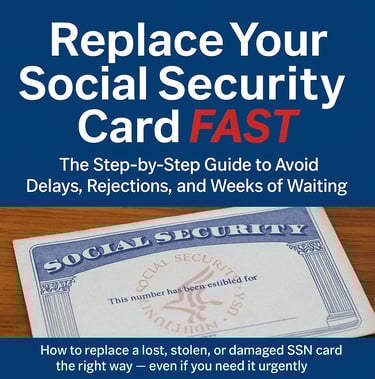
And that’s exactly why we created the Replace Your Social Security Card FAST Guide.
What the “Replace Your Social Security Card FAST Guide” Does Differently
This guide is not about charging you for the card.
It’s about:
Eliminating guesswork
Preventing delays
Avoiding rejections
Choosing the fastest legitimate path
Knowing exactly what the SSA looks for
It walks you step by step through:
Online eligibility checks
Perfectly completed Form SS-5
Document selection strategies
Speed-focused decision trees
Real scenarios with real outcomes
So instead of hoping your free replacement works, you know it will.
Final Truth You Need to Remember
Yes, you can replace your Social Security card for free.
But free doesn’t protect you from mistakes.
And mistakes cost time, opportunities, and peace of mind.
If you want to:
Replace your Social Security card correctly the first time
Avoid weeks of waiting
Reduce stress
Get back control fast
👉 Get instant access to the “Replace Your Social Security Card FAST Guide” now
and follow the proven path that thousands of Americans wish they had known before they started.
Because when it comes to your identity, doing it right is everything—and doing it fast can change everything.
…and if you’re wondering what happens after you submit your application, how to track it, what to do if it gets rejected, and how to handle urgent employment or benefit situations, then the next section explains exactly what to expect once your request is in the system, including the silent processing stages most people never realize exist, and the exact moment when your replacement card is actually generated and mailed, which is why understanding the internal timing matters so much if you are on a deadline and need to plan around the days when the Social Security Administration processes applications versus the days when your request simply sits in a queue waiting for manual review, especially if your identity triggers additional verification because your record includes a previous name change, an old address, or an immigration status update that was never fully synchronized across federal databases, which is why the next part breaks down what really happens behind the scenes after you click submit or drop your envelope in the mail, starting with the moment your application is first scanned into the SSA system and how that initial intake step alone can determine whether your replacement is processed smoothly or quietly stalled before it ever reaches an actual human reviewer who has the authority to approve and issue your new Social Security card and…
continue
…issued your new Social Security card and why understanding that internal flow is the difference between a smooth, free replacement and weeks of unexplained waiting, especially when your livelihood, benefits, or legal compliance depend on timing rather than good intentions.
What Actually Happens After You Apply for a Free Social Security Card Replacement
Most people imagine the process like this:
“I apply → someone checks it → my card gets printed → it’s mailed.”
That assumption is dangerously incomplete.
In reality, your application passes through multiple invisible stages, and delays almost always happen before anyone ever looks at your documents.
Understanding these stages gives you power—because you’ll know when to wait, when to act, and when something has gone wrong.
Stage 1: Intake and System Validation (Where Most Delays Begin)
The moment you submit your request—whether online, by mail, or in person—it enters the SSA intake system.
At this stage:
No human reviews your application
No documents are approved
No card is prepared
Instead, your data is automatically checked against existing SSA records.
This system looks for:
Exact name matches
Date of birth alignment
Social Security Number consistency
Prior name changes
Citizenship or immigration status flags
Replacement limits
If anything doesn’t match perfectly, your application is diverted silently.
You will not receive an email.
You will not receive a letter.
You will not receive a warning.
Your request simply stops moving forward.
This is why so many people say:
“I applied weeks ago and nothing happened.”
In reality, something did happen—but not what they expected.
Stage 2: Identity Verification (The Make-or-Break Point)
If your application passes the automated checks, it moves to identity verification.
This stage differs depending on how you applied.
Online Applicants
If you applied online:
Your identity is verified digitally
Your state ID or driver’s license is cross-checked
Your account activity is reviewed
Even a small inconsistency—such as:
A missing middle name
An abbreviated first name
A hyphenated last name entered differently
can trigger a manual review.
Manual reviews are not fast.
Mail or In-Person Applicants
If you applied by mail or in person:
A human must physically review your documents
Originals must be verified as authentic
Your identity must be confirmed visually or procedurally
If:
Your document is expired
Your photo is unclear
Your information doesn’t align with SSA records
your application is paused.
Again—often without notice.
Stage 3: Manual Review (The Black Hole Stage)
This is the stage people fear the most, because it’s the least predictable.
Once an application enters manual review:
There is no fixed timeline
Processing depends on office workload
Backlogs vary by region and season
Holidays and staffing shortages matter
Your application may sit untouched for days—or weeks.
This is still a free replacement, but time is now the real cost.
Stage 4: Approval and Card Issuance
Only after identity verification is complete does the SSA approve your request.
At that moment:
Your replacement card is authorized
Your record is updated
Your card is sent to a secure printing facility
Important detail most people miss:
Approval does not mean your card is already mailed.
There is a short lag between approval and printing.
Stage 5: Printing, Mailing, and Delivery
Once printed, your card is mailed via:
First-class mail
No tracking number
No signature confirmation
Delivery typically takes:
5–7 business days
Longer in rural areas
Longer during peak seasons
This is why people often say:
“They approved it, but I still don’t have my card.”
That gap is normal—but only if approval actually occurred.
How to Know If Your Free Replacement Is Stuck
The most dangerous part of this process is not knowing whether to wait or intervene.
Here are warning signs your application may be stalled:
More than 14 business days with no confirmation
No status updates online
No returned documents (for mail-in applications)
No card after 3 full weeks
Prior name changes or immigration updates in your history
If any of these apply, waiting longer often makes things worse.
Can You Track a Free Social Security Card Replacement?
This is one of the most misunderstood aspects of the process.
There is no public tracking system for mailed Social Security cards.
You cannot:
Track the envelope
See printing status
View internal notes
If you applied online, you may see a general status message—but it is often vague.
This is why knowing what should happen and when is critical.
What to Do If Your Free Replacement Is Delayed
Here’s where most people panic—and make mistakes.
Common wrong moves:
Reapplying immediately
Mailing new documents without instructions
Visiting an office without preparation
Paying a third party out of desperation
These actions often reset the clock or create duplicate requests that slow everything down.
The correct action depends on:
How you applied
How long it has been
Whether documents were involved
Whether your record includes complications
This decision-making process is exactly where people lose weeks.
Real Example: Free Replacement, Expensive Delay
Angela, 41, Florida
Angela applied online for a free replacement.
She assumed:
Online = fastest
No news = normal
After 18 days, she reapplied by mail.
Result:
Duplicate applications
Conflicting records
Manual review triggered
6-week delay
Her replacement card was still free—but the delay cost her a contract job.
Why Replacement Limits Suddenly Matter
Remember the replacement limits we mentioned earlier?
3 per year
10 per lifetime
Here’s the critical detail:
Every approved request counts—even if it was unnecessary or duplicated.
This is why careless reapplications can hurt you long-term.
Once you approach the limit:
Identity scrutiny increases
In-person visits become mandatory
Processing slows dramatically
What If You Need Proof Before the Card Arrives?
This is where urgency becomes real.
Some employers and agencies accept:
SSA printouts
Receipt confirmations
Temporary verification letters
Others do not.
Knowing:
When you can request proof
What proof is acceptable
How to request it correctly
can save your job or benefits.
This is rarely explained publicly.
Free Replacement for Children: Special Rules
Replacing a child’s Social Security card is also free—but stricter.
You must provide:
Proof of the child’s identity
Proof of your identity
Proof of parental relationship
Errors here are extremely common.
Mail-in rejections for children are among the highest of all categories.
Free Replacement After Identity Theft
If your card was lost due to identity theft:
Replacement is still free
But scrutiny increases
Additional verification may be required
In some cases, replacing the card is not enough—you may need to take protective steps to secure your number.
Why So Many People Search “Replace Social Security Card for Free” and Still Get Stuck
Because “free” is not the problem.
Uncertainty is the problem.
People don’t know:
Which method fits their situation
When waiting is normal
When silence means rejection
How to avoid restarting the process
And the SSA does not proactively explain these things.
The Psychological Cost of Waiting
This process doesn’t just test patience.
It creates:
Anxiety
Fear of identity misuse
Employment insecurity
A feeling of being ignored by the system
That emotional weight is real—and unnecessary if you understand the process from the start.
The Difference Between Hoping and Knowing
When you understand:
Eligibility rules
Processing stages
Timing expectations
Red flags
Correct intervention points
the process becomes predictable.
That predictability is what removes stress.
Why the “Replace Your Social Security Card FAST Guide” Exists
This guide was built for people who:
Know the replacement is free
But can’t afford delays
Can’t risk mistakes
Can’t wait blindly
It doesn’t replace the SSA.
It doesn’t charge for the card.
It guides you through the fastest correct path for your exact situation.
What You Gain by Following a Proven Process
Instead of:
Guessing
Googling conflicting advice
Restarting applications
Waiting in uncertainty
You gain:
Clarity
Speed
Confidence
Control
Final Call to Action
If you want to replace your Social Security card for free and avoid the traps that delay most applicants…
If you want to:
Choose the fastest legitimate method
Prepare documents correctly the first time
Know exactly when to wait and when to act
Protect your identity while you wait
👉 Get instant access to the “Replace Your Social Security Card FAST Guide” now
Because the card may be free—but your time, peace of mind, and opportunities are not.
And if you’re wondering what happens when the SSA does reject an application, how to fix it without restarting from zero, how to handle urgent employment deadlines, or how to replace your card when you’ve already hit the replacement limit, the next section breaks down rejection scenarios step by step, including the exact language the SSA uses when denying requests and how to respond correctly so your follow-up doesn’t trigger additional delays, which is especially critical if you’re already under pressure and can’t afford another reset of the process, because understanding rejection recovery is what separates people who solve this in weeks from those who remain stuck for months, and that’s exactly where we’re going next, starting with the most common silent rejection patterns and how to identify them even when the SSA never sends a formal denial letter and…
continue
…never sends a formal denial letter and leaves you wondering whether you should wait another week or start over, which is precisely how people lose months on a process that should have taken days, so let’s break this down clearly, calmly, and completely, starting with how Social Security card replacement rejections actually happen in the real world—not how people assume they happen.
The Truth About Social Security Card “Rejections”
Most people believe that if their replacement request is denied, they will receive a clear notice saying:
“Your application has been rejected.”
That almost never happens.
Instead, the SSA uses soft failures, silent holds, and procedural pauses.
This is why people say:
“I never heard back.”
“It just stopped.”
“They didn’t say yes or no.”
“My documents were returned with no explanation.”
These are not accidents. They are part of how the system manages volume and risk.
The 5 Most Common Silent Rejection Scenarios
1. Name Inconsistency (The #1 Killer)
This is the most common reason free replacements stall.
Examples:
You entered “Mike” but SSA has “Michael”
You dropped a middle name
You added a married name not fully updated
You used a hyphen that doesn’t exist in SSA records
The system does not correct these.
It pauses.
No notice.
No correction request.
Just silence.
2. Identity Document “Technically Valid” but Functionally Rejected
This happens constantly with mail-in and in-person applications.
Examples:
ID is valid but photo quality is poor
ID is current but issued too recently
ID does not clearly show identifying features
ID name formatting differs from SSA record
To you, the document looks fine.
To SSA, it introduces risk.
Result: manual review or pause.
3. Address Mismatch or USPS Issues
Your card is mailed without tracking.
If:
Your address formatting is incorrect
Your mailbox is shared or unmarked
USPS cannot deliver securely
Your card may be returned to SSA.
You will not be notified.
4. Replacement Limit Flag
If your record shows:
Multiple past replacements
Short intervals between requests
Conflicting applications
Your request may be diverted for additional review—even if you’re still within limits.
5. Duplicate Applications (The Panic Mistake)
This happens when people:
Apply online
Get nervous
Apply again by mail or in person
SSA systems do not merge these cleanly.
They conflict, triggering manual intervention.
What Happens Internally When Your Application Is Flagged
Once flagged:
Your request is removed from automated flow
It waits for a human reviewer
That reviewer may have hundreds of cases
Priority is not based on urgency—it’s based on queue order
This is why “urgent” situations don’t automatically move faster.
The Worst Thing You Can Do After a Silent Rejection
Do not immediately reapply.
Why?
Because:
It resets timelines
It adds complexity
It increases scrutiny
It burns replacement counts
The correct response is situational, not emotional.
How to Recover From a Rejected or Stalled Free Replacement
Recovery depends on three variables:
How you applied
How long it has been
Whether documents were involved
If You Applied Online
If more than 14 business days have passed:
Log into your SSA account
Check status messages carefully
Look for subtle language changes
If no progress appears:
Contact SSA before reapplying
Be prepared with exact application details
If You Applied by Mail
If documents were mailed:
Wait for document return
Do not resend new documents unless instructed
Track timeline from SSA receipt, not mailing date
If documents are returned without explanation:
That is a rejection
Reapplication must be corrected, not repeated
If You Applied In Person
If:
You were told “everything looks fine”
But no card arrives after 3 weeks
Your application likely stalled post-visit.
This requires follow-up—not reapplication.
Urgent Situations: Jobs, Benefits, Deadlines
Here’s the hard truth:
A free replacement is not automatically fast enough for urgent situations.
But that does not mean you have no options.
Depending on your case, you may be able to:
Obtain SSA verification letters
Use employer-accepted interim proof
Schedule targeted in-person visits
Avoid unnecessary restarts
The difference is knowing what to ask for and when.
Example: Free Replacement Under Deadline Pressure
Jason, 27, California
Jason needed his card for a federal contractor onboarding.
He applied online—free.
Day 12: no update
Day 18: panic
Day 19: almost paid a third party
Instead, he:
Identified a name mismatch
Contacted SSA with specific correction
Avoided duplicate application
Result:
Card approved
Delivered on day 24
Still free.
Still stressful—but controlled.
Why SSA Doesn’t “Expedite” Free Replacements
Many people ask:
“Can I pay to speed this up?”
The answer is no.
SSA does not expedite card issuance for fees.
Speed comes from:
Correct initial submission
Eligibility for online processing
Avoidance of flags
Strategic follow-up
The Myth of “Just Go to the Office”
Offices are not shortcuts.
In-person visits:
Still require mailing cards
Still go through verification
Still face backlogs
They are tools—not guarantees.
Emotional Reality Check
At this point, most people feel:
Frustrated
Powerless
Angry at bureaucracy
Afraid of making it worse
That emotional pressure causes mistakes.
The process rewards patience—but informed patience.
Why Most Online Advice Fails People
Most articles:
Oversimplify
Ignore silent rejections
Assume perfect records
Don’t address urgency
Don’t explain recovery
That’s why people keep searching.
The Core Truth You Need to Accept
Yes, replacing your Social Security card is free.
But:
Free does not mean forgiving
Free does not mean transparent
Free does not mean fast by default
Knowledge is the accelerator.
The Role of the “Replace Your Social Security Card FAST Guide”
This guide exists because:
SSA instructions are incomplete
Mistakes are punished with time
Silence creates anxiety
People need certainty, not guesses
Inside the guide, you learn:
Exact wording to use
Eligibility decision trees
Recovery strategies
Deadline-focused paths
Mistake-proof document prep
The Final Decision Is Yours
You can:
Apply for free and hope
Or apply for free and know
If your time, job, or peace of mind matters…
👉 Get the “Replace Your Social Security Card FAST Guide” now
Because the card itself costs nothing—but getting stuck costs everything.
And if you’re asking yourself what happens when someone loses their card repeatedly, how SSA evaluates “risk,” whether changing your Social Security number is ever possible, or how replacement rules differ for non-citizens, survivors, or elderly applicants, the next section answers those questions in full detail, starting with how the SSA decides whether a replacement request signals normal loss or potential misuse, and why that distinction matters far more than most people realize, especially as identity fraud continues to rise and the agency becomes more conservative in how it evaluates even routine requests, which means understanding these deeper rules is no longer optional if you want to avoid future problems and…
continue
…and why that distinction matters far more than most people realize, especially in an era where identity theft, synthetic identities, and document fraud have forced the Social Security Administration to quietly tighten internal controls, even while publicly stating that replacement cards are “routine” and “free,” which is technically true but operationally incomplete, so let’s go deeper into the risk logic that governs how your request is evaluated and why some people sail through while others hit invisible walls.
How the SSA Decides Whether Your Replacement Request Is “Normal” or “Risky”
Every replacement request is evaluated on context, not just content.
The SSA does not look only at:
Your name
Your Social Security number
Your ID document
It also looks at patterns.
These patterns include:
How often replacements have been requested
How recently the last replacement occurred
Whether addresses have changed frequently
Whether names have changed multiple times
Whether applications originate from different channels
Whether prior records show inconsistencies
None of this is explained on public forms.
But all of it influences how fast—or slowly—your “free” replacement moves.
What the SSA Considers a “Normal” Replacement Pattern
A normal pattern looks like this:
One replacement every few years
Clear identity continuity
Stable name and address
Single application method
Clean document history
These requests usually:
Stay in automated flow
Are processed quickly
Are approved without human intervention
This is the ideal scenario.
What the SSA Considers a “High-Attention” Pattern
A high-attention pattern doesn’t mean wrongdoing.
It simply means higher verification requirements.
Examples:
Multiple replacements in short periods
Replacements following address changes
Replacements following name changes
Replacements following identity theft reports
Replacements combined with benefit activity
Duplicate or overlapping applications
These requests are still eligible and still free—but they are slowed down intentionally.
Losing Your Card Multiple Times: What Actually Happens
People often ask:
“What if I’ve lost my card before?”
Losing your card once or twice is normal.
Losing it repeatedly in a short window is not treated the same way.
After several losses:
Automated approval becomes less likely
Manual review becomes standard
In-person verification may be required
Additional identity proof may be requested
This does not mean denial.
It means friction.
Replacement Limits Revisited: Why They Matter More Than You Think
Earlier, we discussed the numerical limits:
3 per year
10 per lifetime
What most people don’t understand is how close you are to those limits matters, even before you hit them.
If your record shows:
Frequent replacement history
Requests clustered together
Past rejections or corrections
Your request is more likely to be flagged.
This is another reason why duplicate applications are dangerous, even if they are technically allowed.
Can the SSA Change Your Social Security Number Instead?
This is a common question—and a source of misinformation.
In most cases:
No, you cannot change your Social Security number
Replacing the card does not change the number
Losing your card does not qualify for a new number
Exceptions exist, but they are rare and strict.
Examples include:
Severe, ongoing identity theft
Abuse or harassment situations
Life-threatening circumstances
Even then, approval is difficult.
For the vast majority of people, the goal is protecting and replacing the card, not changing the number.
Replacing a Social Security Card After Identity Theft
This scenario introduces additional layers.
If your card was stolen or misused:
Replacement is still free
But identity verification becomes stricter
Your record may be flagged for monitoring
In these cases:
Speed depends on documentation quality
Follow-up steps may be required
Credit protection may be recommended
Many people mistakenly believe replacing the card alone solves identity theft. It does not.
Non-Citizens and Free Social Security Card Replacement
Replacement rules differ slightly for:
Lawful permanent residents
Temporary workers
Students
Other eligible non-citizens
Key differences:
Immigration status must still be valid
SSA often verifies status with DHS
Processing times are longer
Online replacement may not be available
The replacement is still free—but patience requirements increase.
Elderly Applicants: Unique Challenges
Seniors often face:
Older records
Name variations
Missing documentation
Pre-digital history
These factors can:
Trigger manual review
Require in-person visits
Extend processing times
Again: free, but not fast by default.
Survivors and Estate-Related Replacements
In some cases, families need a Social Security card replacement related to:
Death benefits
Survivor benefits
Estate administration
These cases involve:
Additional documentation
Relationship verification
Special handling
Mistakes here can delay benefits—not just the card.
Why the SSA Prefers You Don’t Replace Cards Unless Necessary
This may surprise you.
The SSA actually discourages carrying your Social Security card.
Why?
Loss increases identity theft risk
Replacement volume strains systems
Repeated replacements trigger scrutiny
This is why many agencies accept:
The number alone
Alternative verification
Replacing your card should be intentional—not automatic.
When You Actually Need the Physical Card
You typically need the physical card for:
New employment (I-9 verification)
Certain government benefits
Some financial institutions
Immigration-related processes
You do not need it for:
Most tax filings
Credit checks
Many benefit renewals
Knowing this distinction can prevent unnecessary replacements.
The Cost of Doing Nothing
Some people delay replacing a lost card because:
It’s “free anyway”
They don’t need it immediately
They fear the process
This delay can backfire when:
A job offer appears
Benefits are requested
Identity theft occurs
Deadlines suddenly matter
At that point, urgency magnifies stress.
Free Replacement Under Pressure: Why Preparation Is Everything
When pressure exists:
Mistakes increase
Panic leads to duplicates
Bad advice gets followed
Time gets wasted
Preparation turns urgency into execution.
What Preparation Actually Means
Preparation means:
Verifying your SSA record consistency
Choosing the correct replacement method
Selecting the right identity document
Avoiding unnecessary triggers
Knowing when to wait vs. act
This is not intuitive.
It’s learned.
Why the “Replace Your Social Security Card FAST Guide” Saves Time Even Though the Card Is Free
The guide doesn’t change SSA rules.
It changes your execution.
It helps you:
Avoid silent rejections
Stay in automated processing
Recover correctly if stalled
Meet deadlines without panic
Protect your long-term record
The Emotional Shift That Comes With Clarity
When you know:
What’s normal
What’s risky
What’s fixable
What’s not
the process stops feeling hostile.
It becomes procedural.
And procedures can be mastered.
Final, Unfiltered Truth
Yes, you can replace your Social Security card for free.
But the system:
Is not transparent
Is not forgiving
Is not fast by default
Those who succeed quickly are not lucky.
They are informed.
Your Final Call to Action
If you want to:
Replace your Social Security card for free
Avoid delays, flags, and restarts
Handle urgency with confidence
Protect your identity and future requests
👉 Get the “Replace Your Social Security Card FAST Guide” now
Because free is only valuable when it works the first time.
https://replacessncard.com/replace-your-social-security-card-fast-guide
Help
Questions? Reach out anytime.
infoebookusa@aol.com
© 2026. All rights reserved.